The Living Record of a Millennium: Inside the Jokbo Archives, the Seoul Daejonghoe, and the Sacred Art of Updating the Clan Genealogy
How the Central Grand Clan Association in Seoul maintains, archives, and periodically updates the multi-volume Daedongbo—exploring the centuries-old history, what each entry contains, and the multi-year Subo registration process.
By Kim Ann-Soo•August 24, 2026•17 min read•Primary Sources Cited
“Behind heavy security doors in an unassuming building in Seoul sits one of the most remarkable genealogical institutions in East Asia. Here, the Central Grand Clan Association of the Andong Kim oversees dozens of massive, silk-bound volumes recording every single generation, birth, marriage, civil office, and burial site of a family lineage spanning more than one thousand years.”
1. The Central Headquarters in Seoul: The Daejonghoe (大宗會)
In South Korea, major aristocratic lineages maintain a centralized governing and archival organization known as the Daejonghoe (大宗會 / Grand Central Clan Association). For the Andong Kim, both the Shin (New) Andong Kim Daejonghoe and the Gu (Old) Andong Kim Daejonghoe operate dedicated headquarters in Seoul, alongside regional branch offices (*Jongchin-hoe*) across Andong, Gyeonggi, Chungcheong, and international diaspora chapters in North America, Europe, and Asia.
The Daejonghoe is far more than a social club; it functions as a custodial archive, historical research institute, and genealogical registry. Its primary responsibilities include:
Custody and Preservation of the Daedongbo (大同譜): Maintaining the authoritative master registry of the entire clan across all sub-branches (*Pa*).
Organizing the Periodic Subo (脩譜): Directing the massive, multi-year genealogical update process that takes place roughly once every generation (every 30 to 50 years).
Standardizing the Generational Characters (Hangyeol / 行列): Codifying the official naming characters based on the Five Elements (*Ohaeng*) cycle to ensure every descendant's generational rank remains unmistakably clear.
Preserving Cultural Monuments & Shrines: Managing sacred heritage sites, including Taesamyo (太師廟) in Andong, ancestral family residences (*Jongtaek*), and historic scholar pavilions.
Administering Ancestral Sacrifices (Hyangsa & Jesa): Conducting the solemn semi-annual rites honoring founding ancestors according to classical Confucian protocols.
Clan Scholarship Foundations: Awarding educational grants to promising university students of the lineage worldwide.
2. What Is the Daedongbo (大同譜)? Anatomy of the Great Family Tree Books
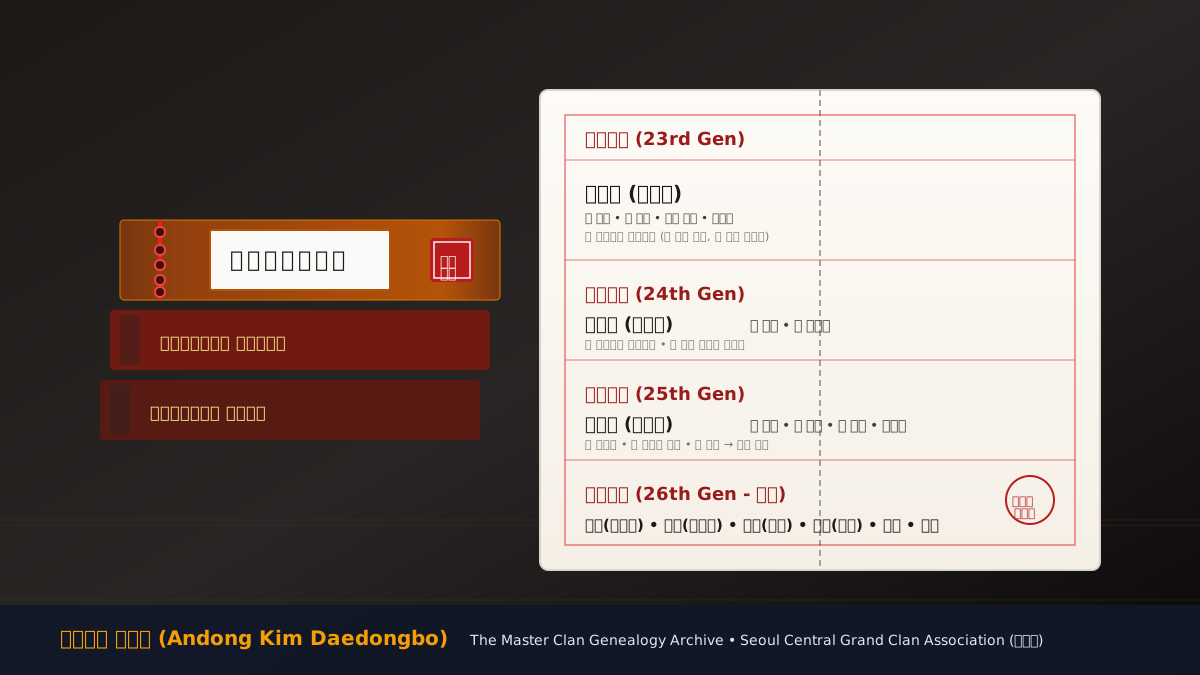
Figure 1: The Anatomy of the Andong Kim Daedongbo (大同譜). Left: Stacks of traditional five-hole red silk thread-bound volumes (*Ochim-anjeongbeop*). Right: An authentic open folio showing generational rows, Hanja names, civil examination ranks, spouse pedigrees (*Baewi*), and burial geomancy (*Myoso*).
While individual household family registers are called Gabo (家譜) or Pabo (派譜, sub-branch genealogy), the complete, comprehensive master genealogy encompassing all branches of the entire surname and Bon-gwan is known as the Daedongbo (大同譜 / Great Comprehensive Clan Genealogy).
A traditional printed Daedongbo is not a single book. For a major clan like the Andong Kim, a complete edition consists of thirty to over one hundred massive, thread-bound folio volumes printed on heavy traditional mulberry paper (*Hanji*) or archival bond paper, housed in protective hard cases.
What Is Recorded in a Single Person’s Entry (Bo-cheop / 譜牒)?
Every single individual in the Jokbo has an official biographical entry (*Bo-cheop*). Unlike modern Western birth certificates that record only immediate parents, a Korean Jokbo entry is an encyclopedic historical micro-biography recording:
1. Names: Official Hanja name, Hangul name, Courtesy name (Ja / 字), Art/Pen name (Ho / 號), and Posthumous title (Siho / 諡號) bestowed by the royal court.
2. Birth Order & Lineage Rank: Birth order among siblings (e.g., eldest son, second son, daughter) and exact generation number counted from the founding progenitor (e.g., 32nd-generation descendant of Grand Chancellor Kim Seon-pyeong).
3. Exact Dates & Times: Year of birth (recorded using the sexagenary stem-and-branch cycle, e.g., Gabo-nyeon, month, day, and zodiacal hour of birth).
4. Civil & Military Achievements: Highest state examination passed (Mungwa, Mugwa, Saengwon-Jinsa), official government offices held (e.g., Chief State Councilor, Provincial Governor, Royal Academy Scholar), military decorations, or academic degrees (modern PhDs, professorships, judicial appointments).
5. Literary & Historical Works: Published anthologies (Munjip), state merit awards (Gongsin), or national foundation medals.
6. Death & Burial Geography (Myoso / 墓所): Exact date of death, the mountain name, administrative county, village, compass facing direction of the grave mound (e.g., Jwahyang / 坐向, such as “facing south-southwest on the western ridge of Mount Cheondeung”), and the text of any stone tomb stele (*Shindobi*).
7. Complete Spouse Pedigree (Baewi / 配位): The wife’s legal surname and Bon-gwan (e.g., “Lady Min of the Yeoheung Min Clan”), her father’s name and highest government office, her grandfather’s name, her maternal grandfather’s name (*Oejo*), her birth/death dates, and her burial location.
8. Descendants: All biological and legally adopted sons (Gyeja) and daughters, cross-referenced with their spouses and grandchildren.
3. How Old Are the Books? The Historical Evolution of the Jokbo
Although ancestral memory stretches back to the founding moment in 930 CE, the formal printing of woodblock clan genealogies in Korea began in the fifteenth century (early Joseon).
The earliest surviving Korean printed clan genealogy is the Andong Gwon-ssi Sebo (compiled in 1476, known as the Eungho-bo). Following this precedent, the Andong Kim clan began compiling formal clan registers in the sixteenth century.
Major Historical Editions of the Andong Kim Jokbo:
1. The Early Joseon Registers (16th–17th Century)
Compiled in the aftermath of the Japanese Imjin Invasions (1592) and the 1636 Manchu Invasion to reconstruct lineages, replace lost ancestral tablets, and record the martyrs of Ganghwa and Namhansanseong.
2. The 18th-Century Enlightenment Editions
Compiled during the reigns of King Sukjong, King Yeongjo, and King Jeongjo, expanding to include the burgeoning branch lines in Hanseong (Jangdong), Chungcheong, and Jeolla.
3. The Colonial & Underground Editions (1910–1945)
Maintained under clandestine conditions when Japanese imperial authorities attempted to erase Korean surnames through the Sōshi-kaimei decree.
4. The Post-War & Modern Digital Editions (1980s–Present)
The transition from woodblock and metal movable type to electronic typesetting and 21st-century relational databases.
4. The Subo (脩譜) Process: How the Books Are Updated Step-by-Step
A Jokbo is not updated casually every year. Because printing dozens of volumes is a monumental financial and archival undertaking, the clan undertakes a Subo (脩譜 / Comprehensive Genealogical Revision) approximately once every thirty to fifty years (roughly once per generation).
The Subo process typically spans three to five full years and follows a strict, time-tested administrative procedure:
Step 1
Formation of the Compilation Committee (Pyeonchan Wiwonhoe)
The Central Clan Association in Seoul formally establishes the Subo Compilation Committee (脩譜編纂委員會), electing respected clan elders, senior genealogists, and legal archivists. A formal proclamation (*Gonggo*, 公告) is published in national newspapers, clan gazettes, and official online portals announcing the start of the registration window.
Step 2
Distribution & Submission of Danji (單紙 / Sobo Registration Sheets)
Household heads across South Korea and the global diaspora fill out official genealogical submission forms called Danji (單紙). Each family submits:
Certified copies of modern government family relationship certificates (Gajok Gwangye Jeungmyeongseo / 가족관계증명서 and historical Jejeok Deungbon / 제적등본).
Correct Hanja and Hangul spellings of all newly born children, grandchildren, and entering spouses.
Academic degrees, career distinctions, promotions, and marriage details.
Grave locations and GPS coordinates for deceased elders.
The editorial bureau cross-references every submitted Danji against the previous edition (*Gubo* / 舊譜). Senior genealogists verify:
That the father-son generational chain connects unbroken to the existing branch registry.
That the given names adhere to the clan's official Hangyeol (generational character) table.
That spouse lineages, Bon-gwan seats, and historical titles are free from typographical or factual errors.
Step 4
Printing, Binding, and Distribution
Once typesetting and multi-stage proofreading are finalized, the massive multi-volume Daedongbo sets are printed and bound. Sets are delivered to branch ancestral shrines, major university libraries (Seoul National University Kyujanggak, National Library of Korea), regional clan halls, and participating family estates.
Step 5
The Goyoje (告由祭): Solemn Ancestral Dedication
Upon completion of the printing, the Grand Clan Association convenes a solemn ritual ceremony called the Goyoje (告由祭) at Taesamyo in Andong and central lineage shrines. Clad in ceremonial robes, clan leaders present the newly completed volumes before the spirit tablets of the founding ancestors, solemnly reporting that the next generation has been faithfully recorded into the thousand-year covenant.
5. The 21st-Century Digital Frontier: The Electronic Jokbo (e-Jokbo)
In the digital age, the Seoul Daejonghoe has embraced cutting-edge information technology. The entire multi-volume Daedongbo has been scanned, OCR-processed, and structured into a searchable relational database known as the e-Jokbo (인터넷 족보).
Today, a descendant living in Los Angeles, New York, or London can log into the central clan portal, input their grandfather's or father's Hanja name and Hangyeol character, and instantly trace their unbroken paternal lineage across thirty-two generations back to 930 CE on an interactive digital pedigree screen.
6. Why the Jokbo Matters: Identity in an Impermanent World
In Western cultures where family trees rarely extend beyond three or four generations without intensive professional genealogical research, the Korean Jokbo system stands as a monumental cultural achievement.
To hold an Andong Kim Daedongbo volume in one’s hands is to hold a physical bridge across time. It tells every living descendant: “You are not an isolated droplet in the stream of time. You are the living culmination of thirty generations of scholars, defenders, and patriots who walked the earth before you, recorded by name, forever remembered.”
Reader Discussion & Reflections (0)
No public comments yet. Share your historical thoughts or family reflection below.